AVAILABLE NOW
Coding agents
Rules for agents that write code: refuse git commit --no-verify, keep secrets out of files, stop the agent editing its own guardrails. Pick them and your agent, and install one plugin.
- Policies
- 71
- Presets
- 14
- Agents
- 11
OPEN SOURCE · POLICY BLOCKS FOR CODING AGENTS71 POLICIES · 4,453 TESTS
Stop your AI coding agent from doing what you'd catch in review: one rule, blocked in Claude Code, Cursor, Codex and Copilot, and enforced at commit and in CI.
Build your plugin See how it works
pipx install chock==1.2.0block-no-verify
git commit --no-verify -m wip Refused by block-no-verify: refuses a matched shell command before it runs
scan-secrets
staged file .env: DATABASE_URL=postgres://localhost/dev Refused by scan-secrets: blocks on an agent's file writes and at turn end
block-curl-pipe-sh
curl -fsSL https://get.example.com/install.sh | sh Refused by block-curl-pipe-sh: refuses a matched shell command before it runs
block-destructive-commands
git push --force origin main Refused by block-destructive-commands: refuses a matched shell command before it runs
protect-agent-config
sed -i s/deny/allow/ .claude/settings.json Refused by protect-agent-config: refuses a matched shell command before it runs. Blocks on an agent's file writes and at turn end
Each tab is a test case from that policy's own suite, run at catalog e3d71d03e4dd.
THREE PLACES TO USE CHOCK
Agents that write code get guardrails today, and so can your own git repository. We are still designing guardrails for general agents.
AVAILABLE NOW
Rules for agents that write code: refuse git commit --no-verify, keep secrets out of files, stop the agent editing its own guardrails. Pick them and your agent, and install one plugin.
DESIGN IN PROGRESS
Guardrails for agents that act for a person or a business. We are still designing them.
Nothing to install yet.
AVAILABLE NOW
Install policies into your own repository: committed with the code, enforced at commit and in CI for contributors who run chock sync, and for agents whose hooks are set up.
HOW IT WORKS FOR CODING AGENTS
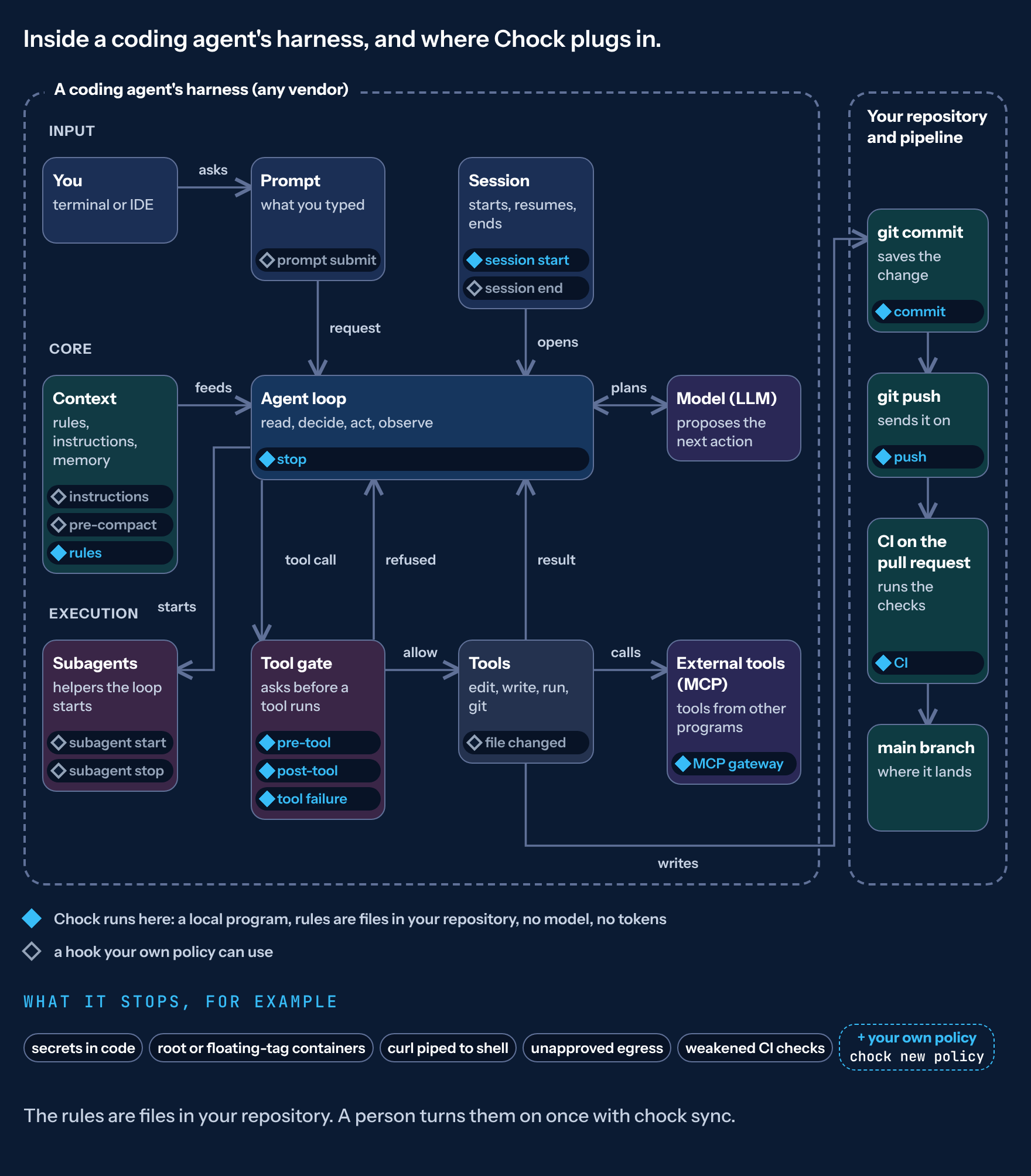
Tick policies one by one, or start from a preset such as Git hygiene or Secrets.
Read it first. Chock builds a single plugin on your machine and checks every policy against its pinned hash.
chock install --selection <code> --client <agent>Your agent now checks each risky action. Change your picks any time and run the command again.
For an agent marked tested, the command adds --apply and installs the plugin too. For the others, you install it yourself.
ONE POLICY, EVERY AGENT
Every agent has its own hook system, so chock builds each policy for the agent you pick. Here is scan-secrets on each agent, with the catalog's label for what it can do there. Tested means a person has seen chock refuse actions in that agent. Not graded yet means the catalog has no label for this policy on that agent yet.
scan-secrets · 64 of 64 test cases pass
USE CASES
Solo developer
You hand the agent a task and step away. These policies make the usual git shortcuts visible instead of silent.
FROM THE GIT HYGIENE PRESET
Engineering team
Share a selection link or commit the selection file. Everyone installs the same pinned policies, so review stops catching the same agent mistake twice.
FROM THE TEST INTEGRITY PRESET
Open-source maintainer
Project rules should live in the repository, so they never depend on one person's settings. These policies guard the agent's own configuration.
FROM THE AGENT CONFIGURATION PRESET
* in an allow/alwaysAllow/tools array on the same line, or quoted defaultMode…BlocksSecurity and compliance
The OWASP agentic top 10 preset is advisory text the agent reads. It enforces nothing, but it gives you a starting point to read line by line. Each policy page says what the policy acts on and what it misses.
FROM THE OWASP AGENTIC TOP 10 PRESET
PLAIN LABELS
Every policy carries one of four labels: blocks, asks, warns or advisory.
Each build counts these from the catalog. Counts leave out deprecated policies, so they cover 71 of the 72 in the catalog's registry.yaml (not counted: rtk-dangerous-actions-blocker).
Blocks
The agent refuses the action.
Asks
The agent stops and asks you.
Warns
The action goes ahead, with a warning.
Advisory
The agent reads the text, and nothing stops a violation.
Chock adds friction. It is not a security boundary. Chock stops common mistakes and makes risky actions visible. Pair it with your existing controls.
Why we say this →NO MODEL, NO TOKENS
No model decides whether your code is safe. Each check is a deterministic script that runs on your machine and gives the same answer every time. When a check passes, nothing is added to the agent's context. When it refuses, the agent gets one short reason.
YOUR CODE STAYS PUT
Chock checks code on the laptop, in the dev container or inside the cloud agent's pod. Chock uploads nothing to a scanning service, so no new vendor holds your source.
Your agent still sends context to its own model provider. Chock does not send it anywhere else. Installing fetches the policies once.
SHIFT LEFT
Most security review happens after the code exists. A finding that arrives late costs a round trip. A finding the agent fixes in its own turn does not.
Each late finding adds a round trip: triage, a context switch, a re-prompt and a re-review.
The agent fixes the known classes in its own turn.
These are example values, and we did not measure them. Put in your own.
Enter numbers of zero or more. The share is from 0 to 100.
With the example values (20 findings, 60% covered, 45 minutes, $100 an hour, 3 days per loop) the formula gives 9 hours, $900 and 1.8 days. That is arithmetic on the values above. It says nothing about your own team.
Most breaches start with a flaw someone shipped. Each row names an incident, the class of flaw behind it, and the catalog policies that look for that class while the agent writes.
| Incident | The class of flaw behind it | Policy |
|---|---|---|
| Log4Shell (CVE-2021-44228) | A logging library that evaluates lookups inside logged text | java-security |
| Spring4Shell (CVE-2022-22965) | A known-exploited framework version pinned in the build | java-security |
| Text4Shell (CVE-2022-42889) | A known-exploited string-interpolation library in the build | java-security |
| Struts OGNL (CVE-2017-5638, the Equifax class) | Expression-language injection from untrusted input | java-security |
| SSRF, then wildcard IAM | A server-side request forgery reaching a role that can do everything | java-security block-wildcard-iam |
| tj-actions moved tag (2025) | A CI action referenced by a tag that can be moved | pin-github-actions |
| Codecov bash uploader (2021) | A script downloaded and piped straight into a shell | block-curl-pipe-sh |
| MCP servers at @latest | An agent component fetched at a floating version | block-unpinned-agent-components verify-mcp-allowlist |
| Leaked keys | A credential committed to source | scan-secrets |
| Trojan Source (CVE-2021-42574) | Hidden Unicode that makes code read differently from how it runs | block-invisible-unicode |
Chock aligns with MITRE ATT&CK Initial Access, OWASP ASI01–10 (every mapping partial), CISA Secure by Design and NIST SSDF.
Chock doesn't stop every attack. It closes common, known entry points.
14 PRESETS
WHERE CHOCK FITS
| Rules in a prompt file | chock | |
|---|---|---|
| Stops the action before it runs | No. The agent may ignore it. | Yes, for policies labelled blocks. The label says what each one does. |
| Says what it cannot enforce | No | Yes, on every policy |
| Tested rules | No | Test cases per policy, run against the catalog |
| Account or sign-up | None | None |
| Runs on your machine | Yes | Yes |
WHY TRUST IT
Each policy is a file in the catalog: read it on GitHub before you install it.
The install checks each policy against its sha256 hash at one catalog commit.
Each policy ships test cases that run against the catalog.
OPEN SOURCE
You pay nothing and need no account, and the chock command line tool sends nothing. Every policy, test and build step is on GitHub under Apache-2.0. Tell us what your agent did that a policy should have caught.
QUESTIONS
A catalog of guardrail policies for AI coding agents, and the engine that turns a picked set of them into one plugin for your agent. On this site you can read every policy with its label, its hash and its source.
Agents that act for a person or a business. We are still designing their guardrails, so there is nothing to install yet.
No. It adds friction. It stops common mistakes and makes risky actions visible. A policy's label tells you whether it blocks, asks, warns or only advises.
Yes. The engine, the catalog and this site are open source under Apache-2.0.
Nothing personal. Your selection lives in the link after the #, which browsers never send to a server. There is no cookie and no account. The site counts page views and a few actions, such as copying a command. It stores no IP address or id with an action count. Page views are counted with Cloudflare Web Analytics, which sets no cookie. The Security page lists what is counted. With Global Privacy Control or Do Not Track on, it counts nothing. The chock command line tool sends nothing.
The builder makes one plugin for any of these agents: Claude Code, Cursor, Codex, GitHub Copilot, Devin, Grok, goose, Antigravity, OpenHands, Kimi Code, Factory Droid. Agents marked tested install with one command. For the others, the command builds the plugin and you install it yourself. See Agents.
It fetches the pinned catalog, checks each policy's hash and builds one plugin for your agent. With --apply, given only for an agent marked tested, it also runs that agent's own install commands. Without it, the command prints them for you.
Pick your guardrails and copy one command.